




What this article covers
If your digital marketing strategy still begins and ends with SEO, you’re optimizing for how consumers searched for financial advisors five years ago. Today, a growing share of the prospects most likely to hire an advisor are starting their search on ChatGPT, asking Gemini for recommendations, or reading AI Overviews at the top of a Google results page — and never clicking through to any website at all. That shift is what Answer Engine Optimization (AEO) is designed to address: ensuring that when an AI tool fields a question about finding a financial advisor, your name and expertise are part of the answer. This guide covers what AEO is, why it matters specifically for financial advisors, the seven most effective strategies to strengthen your AEO now — and why the advisors who start building this infrastructure today will be the hardest to catch later.
When I started Wealthtender in 2019, Google was the undisputed starting point for most consumer research and SEO (Search Engine Optimization) was the primary lever financial advisors had to influence what prospects found when they searched. That world is changing faster than most advisors realize.
Today, a meaningful and growing share of consumers preparing to hire a financial advisor are starting their search by typing a question into ChatGPT, asking Gemini for recommendations, or reading an AI-generated summary at the top of a Google results page and never clicking a single link. By the time they reach an advisor’s website or profile, many have already formed a strong impression of who’s credible in the space.
This shift from search engines that return lists of websites to answer engines that deliver synthesized responses is what Answer Engine Optimization (AEO) is designed to address. And it represents both the most important new frontier in digital marketing for financial advisors and one of the most significant windows of competitive opportunity I’ve seen in the 25+ years I’ve spent in financial services.
Most advisors aren’t thinking about AEO yet. The ones who start now will be the hardest to catch later.
↗️ Related Article: How Financial Advisors Get Found by ChatGPT and AI Search Tools
Key Takeaways
AEO isn’t a replacement for SEO — it’s the next layer financial advisors need to add now, before most competitors realize it exists.
Search Engine Optimization helps advisors rank in Google’s blue-link results. Answer Engine Optimization determines whether an advisor appears in the AI-generated summaries, Featured Snippets, and zero-click answers that are increasingly what consumers see first — or exclusively. As ChatGPT, Gemini, Perplexity, and Google AI Overviews handle more of the research consumers once did by clicking through multiple websites, advisors who aren’t optimized for direct answers are becoming invisible at the most critical moment in the prospect’s decision process.
The most impactful AEO tactics — FAQ schema, structured data markup, and presence on platforms AI tools already trust — are underutilized by the vast majority of advisory firms.
FAQ schema transforms standard Q&A content into machine-readable signals that AI tools actively parse when generating answers. Structured data tags your credentials, services, and reviews in language search engines understand natively. And strategic presence on high-authority third-party platforms amplifies both — giving advisors indexable content on domains AI tools already treat as trusted sources for financial advisor discovery, separate from and additive to an advisor’s own website.
The advisors building AEO infrastructure now are doing so while the vast majority of their competitors haven’t started — and that window won’t stay open indefinitely.
AEO authority compounds over time the same way SEO authority does — through consistent content, accumulated reviews, growing backlinks, and deepening topical credibility across indexed platforms. Advisors who establish their AEO presence now will be significantly harder to displace than those who wait until AI-powered discovery becomes the dominant channel. The gap between early movers and late adopters in SEO took years to close; in AEO, that gap is forming right now.
What Is Answer Engine Optimization (AEO)?
Answer Engine Optimization is the practice of structuring your website, online profiles, and content so that AI-powered tools and search engines surface you by name, by expertise, or by recommendation when consumers ask relevant financial questions, without necessarily requiring them to click through to any website.
Traditional SEO helps you rank in Google’s blue-link results. AEO determines whether you appear in the AI-generated summaries, Featured Snippets, Knowledge Panels, voice search responses, and zero-click answers that are increasingly what consumers see first (or exclusively).
The platforms driving this shift include:
- ChatGPT (OpenAI, backed by Microsoft and powered in part by Bing)
- Gemini (Google)
- Perplexity
- Claude (Anthropic)
- Google AI Overviews (displayed above traditional search results)
- Voice assistants (Siri, Alexa, Google Assistant)
Each of these tools draws on publicly available content (e.g., articles, profiles, reviews, FAQs, and structured data) to generate answers. Advisors whose content is well-structured, credible, and widely indexed across authoritative platforms are the ones these tools cite. Advisors whose content isn’t optimized for direct answers are being filtered out before the search results page ever loads.
Why AEO Matters Now (Not Eventually) for Financial Advisors
I want to be direct about something: AEO is not a replacement for SEO. Traditional search still drives significant volume, and the foundational practices of SEO (e.g., quality content, backlinks, local optimization, site structure) remain essential and directly support AEO. Advisors who have invested in SEO over the years have a meaningful head start. In fact, Google stated this emphatically in a May 2026 Google Search Central article, stating: “The best practices for SEO continue to be relevant because our generative AI features on Google Search are rooted in our core Search ranking and quality systems.”
What’s changing is where the frontier is. And right now, for financial advisors, that frontier is AI-powered discovery.
Here’s what’s happening to search behavior in practice:
- Consumers increasingly ask AI tools for recommendations using natural, conversational language: “Who are the best financial advisors for tech employees with equity compensation in Austin?” rather than “financial advisors Austin Texas”
- Google AI Overviews now appear above traditional search results for a large share of financial planning queries, meaning advisors who don’t appear in the AI summary may not get a second look even if they rank well in traditional results
- Voice search queries which almost always take a conversational, question-based format are almost entirely served by AI-generated responses rather than ranked link lists
- A Wealthtender Research report conducted in 2025 shows that 25% of consumers already plan to use AI tools to find a financial advisor, a figure that will only rise as AI adoption broadens
The implication is straightforward: advisors who optimize only for traditional search are optimizing for a shrinking share of the discovery funnel. AEO addresses the share that’s growing.
The Great Decoupling: How Impressions and Clicks Are Separating
One dynamic that SEO-focused advisors often don’t anticipate is what digital marketing experts are calling “The Great Decoupling” – the growing separation between impressions (how often your content appears in search) and clicks (how often someone actually visits your website as a result).
AI-powered search tools are driving this: Google’s AI Overviews, ChatGPT responses, and other zero-click answer formats all surface advisor information (e.g., names, credentials, specializations, reviews) without requiring the consumer to click through to any website. An advisor can be cited in AI-generated responses many times in a given month and never see a corresponding spike in website traffic.
This doesn’t mean AEO isn’t working. It means the conversion path has changed. Prospects who encounter your name in multiple AI-generated answers build familiarity and trust over time, and when they’re ready to reach out, they often arrive through direct navigation, referral confirmation, or a name search rather than a traditional first click from a search result. Measuring this journey requires thinking differently about attribution, but the business impact is real.
7 Strategies to Strengthen AEO for Your Advisory Firm
If you already have a digital marketing strategy focused on SEO, many of your existing activities are likely already creating some AEO benefit. The strategies below are designed to build on that foundation and close the gaps that matter most for AI-powered discovery specifically.
1. Optimize for Featured Snippets and Google AI Overviews
Google’s Featured Snippets — the boxed answers that appear at the top of search results — and AI Overviews are among the highest-visibility placements available to financial advisors in traditional search. To improve your chances of appearing in either:
- Structure key content on your website in direct question-and-answer format, with the question as a heading and the answer as the immediate following paragraph
- Keep initial answers concise — 40–60 words — before elaborating with supporting context
- Format supporting content with bullet points, numbered lists, and tables that AI tools can parse efficiently
- Use specific, descriptive H2 and H3 headings that mirror the questions your target clients actually type into search bars
The same structural principles that help you earn a Featured Snippet make your content more likely to be cited in AI Overviews and third-party AI tool responses. These aren’t two separate optimization targets — they’re the same discipline applied consistently.
2. Build and Optimize FAQ Content — With Schema Markup
FAQ sections have been standard practice for advisor websites for years. But there is a meaningful difference between FAQs written for human readers and FAQs structured for AI discovery — and that difference is schema markup.
FAQ schema is a type of structured data code that marks up your question-and-answer content in a way that tells search engines and AI tools exactly what they’re looking at. It transforms your FAQ from a formatted web page into a machine-readable signal that AI tools can identify and extract when generating answers to consumer queries. Without it, your FAQ content competes for AI attention the same way every other paragraph on your website does. With it, your content is explicitly flagged as the kind of structured, direct answer AI tools are looking for.
The same principle extends beyond your own website. Any platform where you maintain a profile — and that implements FAQ schema on your behalf — is contributing to your AEO reach. When you publish FAQs on a high-authority third-party platform, those FAQs are indexed by Google and Bing with the same structured signals as content on your own site, amplified by the domain authority of the platform itself.
↗️ Related Article: How Financial Advisors Can Use FAQs to Show Up in AI Tools and Search Engines
3. Write Conversationally — Match How Prospects Actually Ask Questions
AI tools are trained on natural language. They’re built to understand and answer questions the way people actually ask them — conversationally, in complete sentences, often starting with “how,” “what,” “should I,” or “who.” Content written in formal, keyword-dense prose is significantly less likely to be extracted as an AI-ready answer than content written the way a financial advisor would actually explain something to a client.
In practice, this means:
- Write answers to financial questions in plain, direct language — as if you were answering a client in a meeting, not drafting a compliance document
- Incorporate long-tail keyword phrases that mirror natural speech (“Should I do a Roth conversion before I retire?” rather than “Roth conversion retirement strategies”)
- Lead with the answer, then provide supporting context — AI tools extract the first clear statement of an answer most reliably and use what follows for elaboration
- Structure longer explanations so a reader scanning the first sentence of each paragraph would still follow the core argument
This principle applies equally to your own website content, your contributions to third-party platforms, and any Q&A or Ask an Advisor responses you publish publicly.
4. Build Authority Through Media Mentions, Backlinks, and Verified Client Reviews
AI tools weight credibility heavily when deciding which sources to surface. Two of the clearest signals of credibility in the eyes of an AI tool are being cited by other authoritative sources and being reviewed favorably by real clients on platforms those tools treat as trustworthy.
For financial advisors, the most effective tactics for building AI-visible authority include:
- Earning media mentions — being quoted as an expert source in personal finance articles through programs like Wealthtender’s Quoted feature, HARO (now Connectively), or direct outreach to journalists covering financial planning topics
- Publishing in industry outlets — contributing thought leadership to recognized industry publications establishes topical authority that AI tools weight when deciding which advisors know a subject deeply
- Collecting client reviews on platforms with structured data — reviews on platforms that implement AggregateRating schema communicate your credibility to search engines and AI tools in a structured, machine-readable format, not just as unstructured text. Those gold-star ratings that appear in Google search results are a direct product of schema-marked reviews on platforms AI tools have learned to trust
- Earning backlinks from authoritative sources — each inbound link from a credible website is a vote of confidence that search engines and AI tools interpret as evidence of authority
These signals don’t just improve your traditional search rankings — they’re among the strongest inputs AI tools use to determine which advisors are genuinely credible versus simply present online.
5. Add Schema Markup to Your Website — the Technical Signal AI Tools Weight Most
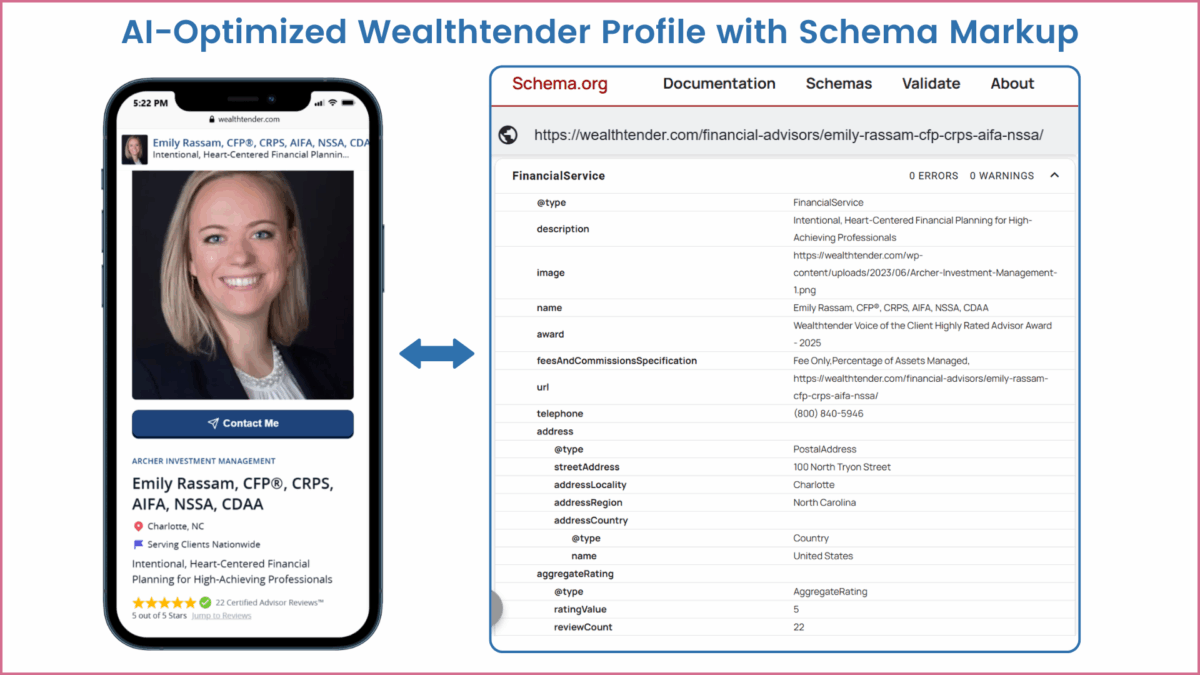
Structured data is the technical backbone of AEO. While FAQ schema is one important type, several additional schema types are directly relevant for financial advisors:
- Person schema — tags your name, credentials, employer, and professional profile in a format search engines understand natively
- LocalBusiness / FinancialService schema — identifies your firm, services offered, service area, and contact information
- Review / AggregateRating schema — communicates your client review data in a machine-readable format, enabling the star ratings that appear in Google search results
- PotentialAction schema — enables direct actions (scheduling a consultation, sending an inquiry) to be surfaced in search results without requiring a click through to your website first
The majority of financial advisor websites have not implemented the full range of relevant schema types — which means doing so creates an immediate, durable competitive advantage over advisors whose sites Google and AI tools are interpreting with less precision. Working with your website developer to audit your current structured data and fill the gaps is one of the highest-leverage technical investments in the AEO toolkit.
6. Build Thematic Content Clusters Around Your Specializations
AI tools don’t just evaluate individual pages — they assess the topical authority of an entire website or profile on a given subject. An advisor who has published five deeply substantive, interlinked articles on retirement income planning signals far more expertise on that topic than an advisor with a single retirement planning service page.
Content clustering means organizing your content into connected hubs: a central pillar page covers a broad topic comprehensively, and multiple supporting pages or articles address specific subtopics in depth, all interlinked. Some examples for financial advisors:
- Retirement Planning Hub → Roth conversion timing, RMD strategies, sequence of returns risk, Social Security optimization, Medicare IRMAA
- Equity Compensation Hub → RSUs, ESPPs, NQSOs, ISOs, 10b5-1 plans, concentrated stock positions
- Business Owner Hub → Solo 401(k)s, buy-sell agreements, exit planning, succession strategy
The same principle applies beyond your own website: contributing FAQ answers, Q&A articles, and educational content to platforms that serve your target audience builds topical authority across multiple indexed sources simultaneously — compounding your AEO reach without requiring an equivalent increase in your own content production.
7. Get on the Platforms AI Tools Already Trust to Find Financial Advisors
Your own website is one signal among many that AI tools evaluate. Your presence on third-party platforms — particularly those with strong domain authority that AI tools have already identified as reliable sources for financial advisor information — can significantly amplify your AEO coverage in ways that no amount of work on your own site alone can fully replicate.
The key principle is that AI tools learn to trust platforms that aggregate credible, structured, independently-verified information about professionals in a category. In financial services, the platforms that currently meet that standard include:
- Wealthtender — advisor and firm profiles with schema markup for financial services, FAQs, and verified client reviews; indexed by Google and Bing; content regularly cited by ChatGPT, Gemini, Perplexity, and other AI tools in response to financial advisor queries
- FINRA BrokerCheck and SEC IAPD — regulatory databases treated by AI tools as authoritative sources for credential verification
- LinkedIn — a high-authority professional network frequently cited in AI responses to professional recommendation queries
- Google Business Profile — relevant for local SEO and trust signals; advisors should be aware of the compliance considerations that apply to Google Reviews specifically
Maintaining complete, updated, review-rich profiles across the platforms AI tools most frequently cite is one of the most durable AEO investments an advisor can make. Unlike content creation, which requires ongoing effort to remain current, a well-structured profile on a trusted platform compounds in value over time without requiring continuous maintenance.
SEO vs. AEO for Financial Advisors: Side-by-Side Comparison
| Established SEO for Financial Advisors | AI-Era AEO for Financial Advisors | |
|---|---|---|
| Purpose | Rank higher in Google and other search engines to attract organic website traffic | Appear in AI-generated answers, Featured Snippets, and voice search responses — with or without a click |
| Focus | Keywords, backlinks, local SEO, domain authority, technical site health | Structured data, conversational content, direct answers, multi-platform credibility signals |
| Search Intent | Consumers browsing for financial services, educational content, or local advisors | Consumers seeking direct answers to specific financial questions or advisor recommendations |
| Ranking Factors | Keyword optimization, link equity, content quality, technical site performance | Schema markup, answer clarity, source credibility, cross-platform presence |
| Content Format | Blog posts, service pages, guides, case studies, whitepapers | FAQs, Q&A content, structured data, conversational articles, direct-answer pages |
| Consumer Interaction | Consumer clicks through to advisor website or third-party profile | Consumer receives a direct answer — advisor may be cited without a click ever occurring |
| Optimization Tools | Google Search Console, Ahrefs, Moz, SEMrush | Schema validators, Google’s Rich Results Test, AI tool testing by name and topic |
| Time to Impact | Weeks to months for new content; compounds steadily over time | Similar timeline; benefits accelerate when using platforms with existing domain authority |
| Best For | Generating consistent organic search traffic and inbound leads over time | Getting cited in AI-generated answers, zero-click results, and voice search responses |
The most effective digital marketing strategy for financial advisors combines both. The foundational work SEO requires (e.g., quality content, structured data, authoritative backlinks, complete third-party profiles) directly supports AEO as well.
The most effective digital marketing strategy for financial advisors in 2026 and beyond treats SEO and AEO as complementary disciplines, not competing ones. The investments required for strong SEO — quality content, structured data, authoritative inbound links, complete third-party profiles — are largely the same investments that drive strong AEO. The difference is in how deliberately you structure that content for AI-readable extraction.
Your AEO Action Plan: Where to Start
The full set of strategies above may feel like a significant undertaking for advisors managing a practice and a marketing strategy simultaneously. Here’s how to prioritize:
Start this month:
- Search your own name and firm name in ChatGPT, Gemini, and Perplexity — what comes back tells you exactly where your current AEO baseline stands and where the most visible gaps are
- Audit your existing FAQ content and ask your website developer to add FAQ schema markup to any FAQ sections on your site
- Run your website through Google’s Rich Results Test (available free at search.google.com/test/rich-results) to identify structured data gaps
In the next 90 days:
- Ensure your profiles on Wealthtender and other third-party platforms AI tools most frequently cite are complete, accurate, and include FAQ content where supported
- Identify two or three content clusters aligned with your specializations and begin building or connecting related articles and pages
- Submit or update your Google Business Profile and verify your SEC/FINRA public profile information is current
Ongoing:
- Collect client reviews on platforms with schema-marked structured data — they are trust signals for prospects and credibility signals for AI tools simultaneously
- Contribute expert answers and Q&A content to platforms that index your responses with appropriate authority
- Update high-performing existing content regularly — AI tools weight recency alongside topical authority
- Monitor which AI tools cite you and for which queries, and use those gaps to guide your next content priorities
The advisors building AEO infrastructure now are doing so in a competitive landscape where the majority of their peers haven’t started. That advantage is real — and it won’t stay available indefinitely.
Want to see how individual advisors and leading wealth management firms are successfully using Wealthtender to grow their business? Visit Wealthtender.com/grow or schedule a demo to learn how you can start converting more prospects into clients with compliant testimonial marketing.

About the Author
Brian Thorp
Brian is CEO and founder of Wealthtender and Editor-in-Chief. He and his wife live in Austin, Texas. With over 25 years in the financial services industry, Brian is applying his experience and passion at Wealthtender to help more people enjoy life with less money stress. Learn More about Brian
Join the digital marketing platform rated extraordinary by advisors.
– T3 Advisor Software Survey, 2023 & 2024
Take an Interactive Tour of Wealthtender
Get hands-on and discover why hundreds of advisors and wealth management firms
choose Wealthtender as their digital marketing partner.
Book a Demo
Select a day in the calendar below to schedule a meeting
with Brian Thorp, Wealthtender founder and CEO.