

What this article covers
Your first round of client reviews was a meaningful accomplishment — and it put you ahead of the 90% of advisors who still haven’t asked. But if you’ve been coasting on that initial effort, your review profile may be quietly falling behind, even as your client relationships continue to grow stronger. Reviews age. Prospects notice. Search engines and AI tools weight recency. This guide explains why ongoing review outreach matters more than most advisors realize, why wealth management requires a different cadence than the transactional professions that have been doing this longer, and how to build a sustainable, compliant process — including two ready-to-use email templates and a CRM and AI meeting tool workflow — that keeps fresh reviews flowing in year after year.
Congratulations. You did something the majority of financial advisors still haven’t done: you invited your clients to write reviews. You drafted the email, cleared it with compliance, hit send, and watched your glowing testimonials begin to roll in. That was a meaningful step, and it put you ahead of 90% of advisors still sitting on the sidelines.
But your first round of reviews was just the opening chapter. If you’ve been coasting on that initial effort without a plan for what comes next, your review strategy may be quietly falling behind, even as your client relationships continue to grow stronger every year.
In this article, we’ll explain why ongoing review outreach matters, why wealth management presents a unique set of challenges compared to other professions that have been doing this longer, and how you can build a sustainable, compliant, and client-friendly process for keeping your review profile fresh year after year.
Key Takeaways
Asking for reviews once is not enough — ongoing outreach is essential.
A single round of review invitations is a great start, but reviews age over time. Advisors who treat review outreach as a one-time campaign risk their review profile getting stale, reducing SEO/AEO benefits and costing them credibility with prospects who look to recent reviews for social proof.
Wealth management requires a different review cadence than transactional professions.
Unlike doctors or lawyers who can tie review requests to discrete appointments or case closings, financial advisors serve clients in an ongoing relationship with no natural finish line. This makes it critical to identify recurring, relationship-driven moments — like annual client meetings or firm anniversaries — to re-invite clients to share their experience compliantly and gracefully.
Building review outreach into your CRM and annual meeting process turns it from a chore into a habit.
Advisors who systematize their review outreach — using CRM automation, AI meeting tools, and annual client touchpoints — generate a steady, compliant stream of new reviews without it feeling awkward or burdensome for clients. The key is consistency: a modest but regular flow of fresh reviews is far more valuable than an occasional spike.
Table of contents
- Why Financial Advisors Need to Ask Clients for Reviews More Than Once
- Why the Doctor and Lawyer Playbook Doesn’t Fully Apply to Financial Advisors
- How Financial Advisors Should Structure Ongoing Review Outreach
- Compliant Email Templates for Asking Financial Advisor Clients to Write Reviews
- How to Automate Ongoing Client Review Outreach Using Your CRM and AI Meeting Tools
- Lessons From Doctors and Lawyers on Building a Consistent Review Culture
- How Wealthtender Helps Financial Advisors Collect Reviews Compliantly and Consistently
Why Financial Advisors Need to Ask Clients for Reviews More Than Once
When you sent your first-round review invitations, you were thinking about a moment. What most advisors don’t anticipate is that reviews, like any content, have a shelf life.
Across any type of business, consumers don’t just count reviews they look to see when they were written. Research in the legal profession has found that recency of reviews is one of the most important factors in how much weight prospective clients assign to them. The same behavioral tendency, albeit to a lesser degree given the long-term nature of advisor/client relationships, could be expected when evaluating financial advisors as well.
Think about it from a prospect’s perspective. You’re considering working with an advisor and you pull up their Wealthtender profile. You see eight glowing reviews, all from three years ago. Compare that to an advisor with five reviews, three of which are from the past six months. Who feels more active, more trusted, more current? Almost always, the latter.
Beyond consumer perception, there is a practical SEO and answer engine optimization (AEO) argument as well. Search engines and AI tools that power recommendation engines give greater weight to businesses with consistent, recent review activity. A profile that continues to earn reviews over time is a profile that continues to earn the greatest visibility.
The conclusion is simple: your first round of reviews built a foundation. But building the structure on top of that foundation requires an ongoing commitment.
Why the Doctor and Lawyer Playbook Doesn’t Fully Apply to Financial Advisors
To understand why ongoing review outreach feels harder for wealth managers than for other professions, it helps to look at how doctors and lawyers handle it because they’ve had much more time to develop their playbooks. While both professions, like financial advisors, survive and thrive based on consumer trust, there are differences worth noting.
A physician’s practice is inherently transactional in cadence. Every appointment is a discrete event and a natural moment of reflection that lends itself to an immediate ask. A patient finishes their visit, feels grateful for the care they received, and receives a follow-up text or email asking them to share their experience. The review request matches the moment.
Law firms face similar dynamics. As one legal marketing guide describes it, review requests work best “within one to two weeks after case closure, when details are fresh and positive emotions are still present.” The end of a legal matter creates a moment of resolution and relief, a natural trigger for asking a client to reflect on their overall experience.
Wealth management is different in a fundamental way: there is no finish line. Your client relationship doesn’t end with a discharged diagnosis or a closed case. It is, by design, an ongoing relationship intended to span years, decades, and in many cases, generations. That’s the beauty of what you do, and it’s also what makes the review ask more complex.
When you invite a longtime client to write a review, they’re not reflecting on a single interaction. They’re reflecting on the entirety of a relationship that may include bull and bear markets, major life transitions, estate planning conversations, and the quiet reassurance of knowing someone is looking out for their financial future. That’s a richer, deeper experience to articulate, and that’s actually a good thing for the quality of reviews you’ll receive. But it means the “timing” question is less obvious than it is for a doctor or a lawyer.
There is an additional wrinkle specific to wealth management: the question of what to do about clients who have already written a review. This creates a real tension. You want to keep your review profile fresh. But you don’t want to create awkward pressure for a client who already came through for you once. And from a compliance standpoint, you remain obligated to avoid cherry-picking which means your approach to ongoing outreach needs to remain systematic and consistent, not targeted at select clients.
How Financial Advisors Should Structure Ongoing Review Outreach
Given these dynamics, how should advisors think about reigniting and sustaining their review efforts over time? The answer lies in shifting from a campaign mindset to a culture mindset.
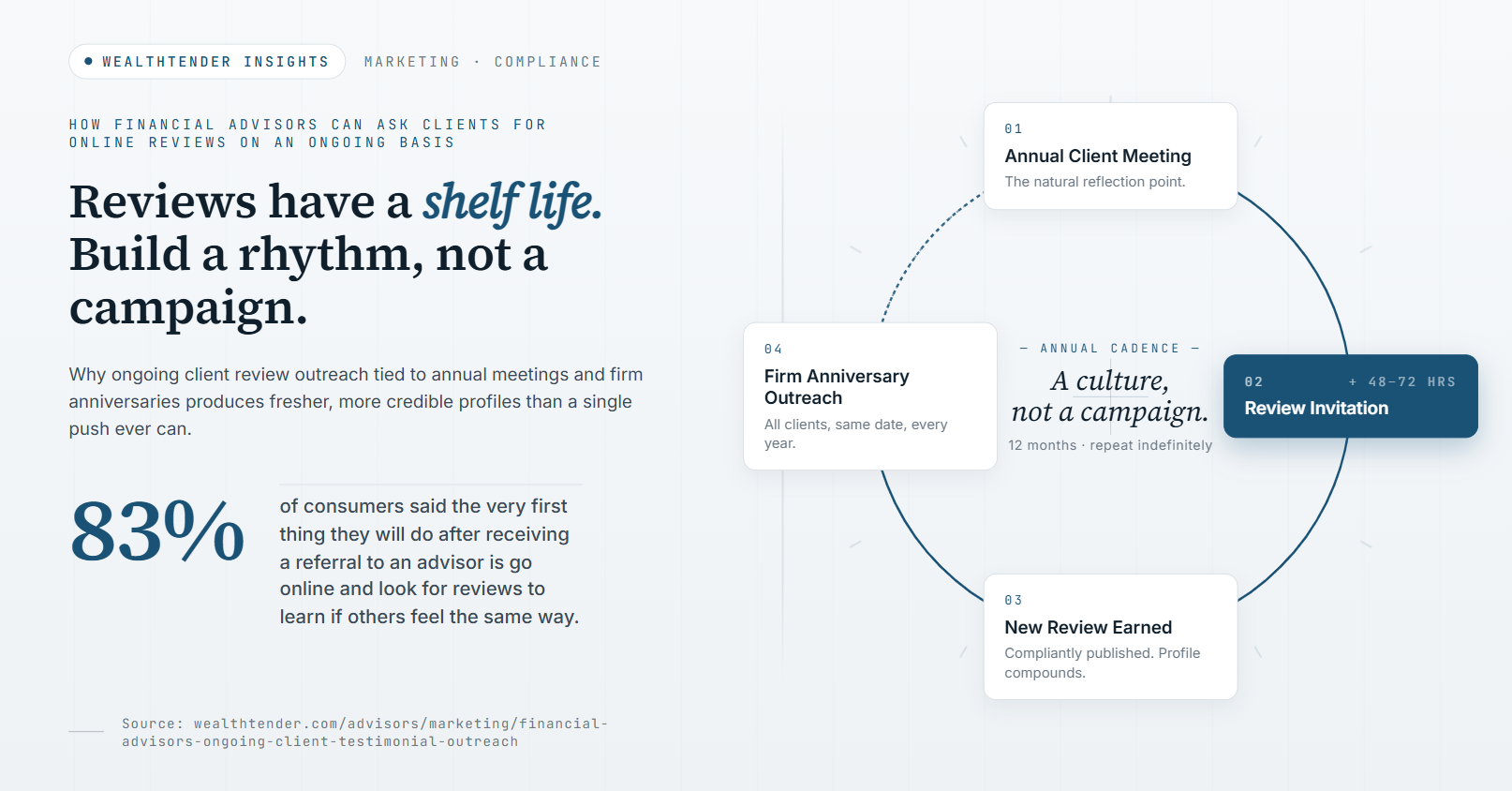
A campaign is something you launch, run, and conclude. A culture is something you embed in your workflows, your team habits, and your client communications. The advisors who will build the most powerful review profiles over the next five years won’t be the ones who do one big annual push. They’ll be the ones who have woven review outreach into the rhythmic fabric of how they serve clients every year.
Here are two primary frameworks to consider:
Strategy 1: Send an Annual Review Invitation to All Clients
One of the most elegant solutions to the “how often do we ask?” question is the annual firm-wide invitation, a message sent to your entire client list on approximately the same date each year (for example, the anniversary of your firm).
This approach has several advantages:
- It treats all clients equally, which is essential for demonstrating to regulators that you are not cherry-picking reviewers.
- It establishes a predictable, firm-wide rhythm rather than an ad hoc, person-by-person approach.
- It frames the ask as an expression of gratitude rather than a request for a favor.
The annual touchpoint also gives you a graceful way to re-invite clients who have already written a review. The message can be framed to acknowledge that some recipients may have already shared their feedback – thanking them for having done so – while gently opening the door for them to update or add to their review if their experience has continued to evolve.
Think about how this might feel to a client: you’re not asking them to repeat themselves or do something they’ve already done. You’re inviting them, if they’re willing, to share how the relationship has grown. That’s a meaningful distinction.
Strategy 2: Ask for a Review Within 48 Hours of Every Annual Client Meeting
The annual client review meeting, already a cornerstone of most advisory practices, is an ideal natural trigger for a review invitation. It’s the one moment each year when a client is most engaged with the breadth of their relationship with you, thinking holistically about their financial picture, their goals, and the progress they’ve made.
That reflective energy is precisely the mindset that produces rich, authentic reviews.
Rather than asking for a review during the meeting itself (which can feel awkward and transactional), the most effective approach is to send a brief, personal follow-up email within a few days of the meeting concluding. The timing is important: the conversation is still fresh, the client is likely in a positive frame of mind, and the ask arrives as a natural extension of the touchpoint rather than an unrelated cold request.
This approach also integrates cleanly into CRM-based workflows, which we’ll discuss in more detail below, making it something your team can execute consistently rather than something that depends on an individual advisor remembering to follow up.
Compliant Email Templates for Asking Financial Advisor Clients to Write Reviews
The art of re-inviting clients to write reviews, especially clients who have already done so, is to make the ask feel warm, purposeful, and genuinely optional. Your work ethic and culture of compliance requires that you not pressure clients or selectively target favorable ones. Good judgment requires that you not make anyone feel obligated or uncomfortable.
The language below is designed to honor both of these principles.
Template 1: Annual Client Review Invitation Email (For All Clients, Including Those Who’ve Already Written a Review)
Template 1: Annual Firm-Wide Review Invitation
For All ClientsTemplate 2: Post-Annual Meeting Review Request Email
Template 2: Post-Annual Meeting Review Request
After Client MeetingHow to Automate Ongoing Client Review Outreach Using Your CRM and AI Meeting Tools
Knowing what to say is only part of the equation. The advisors who succeed at ongoing review outreach are the ones who have removed the burden of remembering to do it. That means building the process into your systems, not your willpower.
Here’s how to make it systematic:
Use Your CRM to Automate Annual Outreach
Most modern CRM platforms used by advisors (including Salesforce, Redtail, and Wealthbox, among others) allow you to set recurring tasks or automated email triggers based on specific dates or relationship milestones. Configure your CRM to flag all active clients for a review outreach campaign once per year, tied to either the anniversary of your first review push or a fixed date meaningful to your firm.
Tag clients who have already submitted a review so you can customize the messaging accordingly, sending one version to first-time recipients and a subtly different, appreciative version to those who have already written one. This segmentation keeps the communication thoughtful without crossing into the territory of cherry-picking, since both messages go out to entire cohorts rather than selectively chosen individuals.
How AI Meeting Tools Like Jump.ai and Zocks Can Automate Your Review Follow-Ups
AI-powered meeting and note-taking tools like Jump.ai, Zocks, and others are transforming how advisors capture and act on client meeting insights. These tools don’t just summarize conversations, they can trigger post-meeting workflows based on what was discussed.
If your firm uses one of these tools, work with your team to configure a workflow that adds a review follow-up task to the advisor’s queue whenever an annual review meeting is logged. The task can include a pre-drafted email template (like Template 2 above) that the advisor can review, lightly personalize if desired, and send with minimal friction.
This approach accomplishes something important: it turns review outreach from something advisors have to remember to do into something the system prompts them to do. That’s the difference between a process and a culture.
Assign Ownership: Who on Your Team Is Responsible for Review Outreach?
Just as healthcare practices train their front-desk staff to request reviews as a natural part of the checkout process, advisory firms benefit from making review outreach a team responsibility rather than a solo advisor task. Designate someone, whether an operations coordinator, a client service associate, or a marketing lead, as the person accountable for ensuring the annual outreach goes out on schedule and that post-meeting follow-ups are sent within a defined window (ideally within 48 to 72 hours of the meeting).
Track it as you would any other business metric. How many review invitations went out this year? What’s the response rate? How many new reviews were added to the profile? Giving the process the same visibility you give other growth metrics ensures it doesn’t slip through the cracks during busy stretches.
Lessons From Doctors and Lawyers on Building a Consistent Review Culture
Doctors and lawyers have had years of practice building review cultures and there are lessons worth borrowing.
The most important one is this: consistency matters more than volume. Legal marketing research consistently finds that a modest but steady flow of reviews is more valuable to online visibility and consumer trust than a large spike followed by a long silence. The same logic applies for financial advisors. Ten thoughtful reviews added across the course of a year do more for your profile than thirty collected in January and nothing thereafter.
The second lesson is about framing the ask around the relationship, not the transaction. Law firms that have cracked the code on ongoing review outreach have learned to invite clients to share how it felt to work with them, the communication, the responsiveness, the sense of being cared for, rather than asking them to narrate specific outcomes or case details. That reframe makes the ask feel less vulnerable and more genuine.
For financial advisors, this is especially resonant. You’re not asking a client to describe their portfolio returns. You’re inviting them to share what it feels like to know that someone is helping them navigate the complexity of their financial life with care and expertise. That’s a story most clients are happy to tell, if you give them an easy, comfortable way to do it.
How Wealthtender Helps Financial Advisors Collect Reviews Compliantly and Consistently
Building an ongoing review culture is only valuable if it’s built on a compliant foundation. That’s where Wealthtender’s platform is purpose-built to support you.
Unlike general consumer review platforms which lack the infrastructure to address the SEC Marketing Rule’s prohibitions and disclosure requirements, Wealthtender’s Certified Advisor Reviews™ are designed from the ground up with regulatory compliance in mind. That means:
- Required disclosures are built into the review display, ensuring that reviews you promote meet the SEC’s disclosure requirements for testimonials and endorsements.
- A compliant review collection process helps you demonstrate to regulators that you are inviting reviews broadly and consistently, not cherry-picking favorable clients.
- A profile that compounds over time, so every new review you collect builds on the ones before it, deepening your profile’s credibility and visibility with consumers, search engines and AI answer engines.
If you’re just getting started with testimonial marketing or want to understand how Wealthtender can support your ongoing strategy, we invite you to explore our Ultimate Advisor Guide to Testimonial Marketing and our SEC Marketing Rule guide to asking for testimonials.
The first round of reviews was your beginning. With the right process in place, the next round, and every one after it, can become one of the most valuable habits you build as a marketer and as a trusted advisor to the clients who count on you.
This article is for informational purposes only. Nothing herein constitutes legal, compliance, or investment advice. Financial advisors should consult with their compliance team and legal counsel before implementing any review outreach strategy.
Want to see how individual advisors and leading wealth management firms are successfully using Wealthtender to grow their business? Visit Wealthtender.com/grow or schedule a demo to learn how you can start converting more prospects into clients with the industry’s first digital marketing platform for AI-optimization and compliant online reviews.

About the Author
Brian Thorp
Brian is CEO and founder of Wealthtender and Editor-in-Chief. He and his wife live in Austin, Texas. With over 25 years in the financial services industry, Brian is applying his experience and passion at Wealthtender to help more people enjoy life with less money stress. Learn More about Brian
Book a Demo
Select a day in the calendar below to schedule a meeting
with Brian Thorp, Wealthtender founder and CEO.